ANCIENT MEALS · 001 / 100
Old Babylonian · Southern Mesopotamia, modern Iraq · Approximately 1750–1700 BCE
Evidence: adapted surviving recipe. The historical evidence and modern cooking choices are distinguished below.
A dinner written in clay
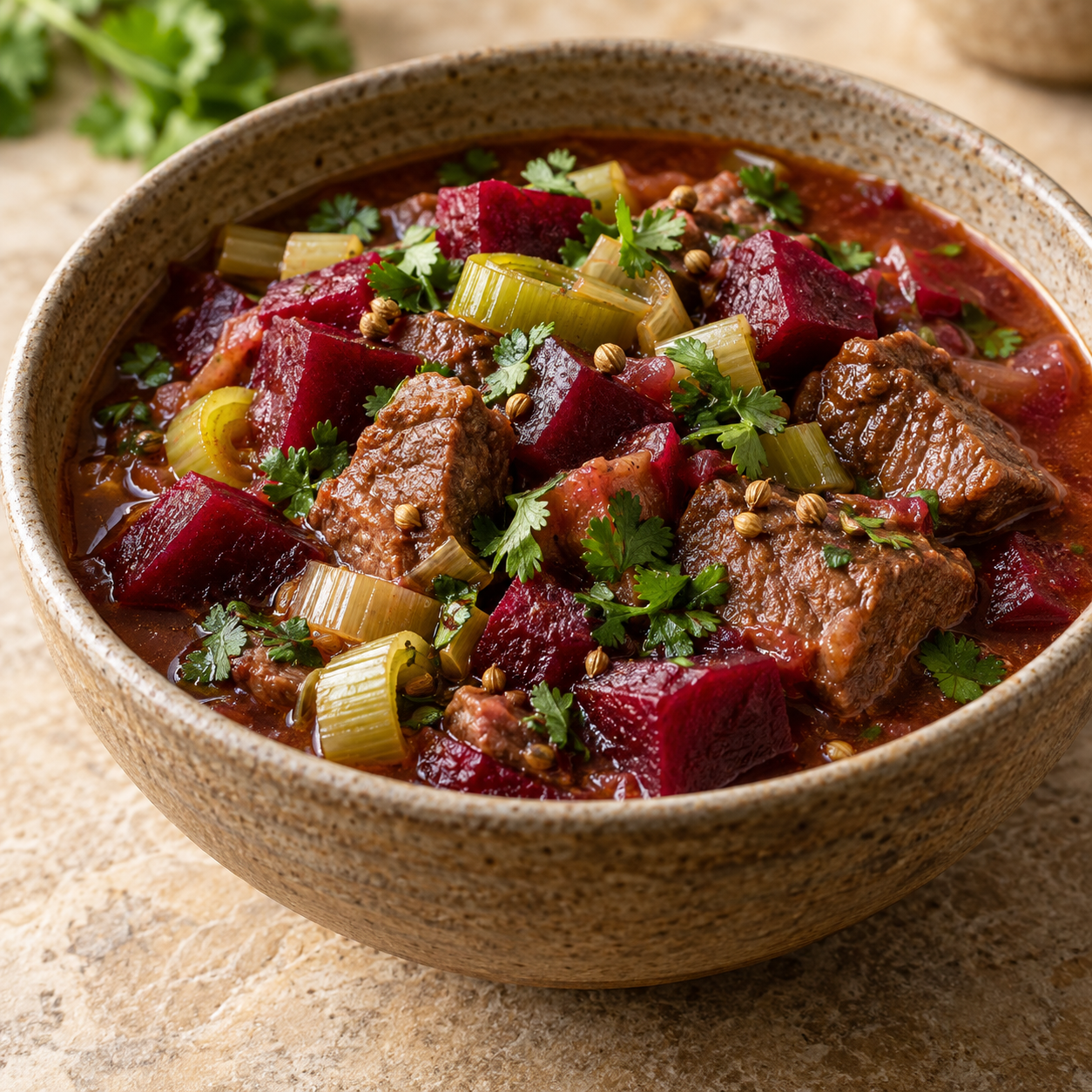
The first surprise is the colour: a bowl of lamb stew turns ruby when beetroot releases its juice. The second is how familiar the cooking feels. You heat fat, add meat, introduce aromatic vegetables and finish with herbs. Yale’s modern reconstruction of tuh’u follows that sequence while making quantities explicit. Its clay-tablet predecessor belongs to Old Babylonian southern Mesopotamia, roughly the eighteenth century BCE.
This was a written cooking instruction, rather than a modern recipe found intact in a tomb. The surviving source names ingredients and actions but leaves much to the cook. The Cuneiform Digital Library Initiative’s object record places the relevant tablet in the broader Old Babylonian period and identifies it as a collection of short stew instructions. The relationship between a concise inscription and a measured kitchen method is the central puzzle here.
Reading a stew without overreading it
Our version uses lamb shoulder instead of the leg cut favoured in Yale’s published adaptation, because shoulder tolerates an extended simmer. That is a practical choice for this recipe, not a newly deciphered ancient detail. We also reduce the quantity of added fat and provide water as an alternative to commercial beer. These adjustments mean the result should be called an adaptation, even though its main flavour combination comes from a surviving text.
Do not picture beetroot as a substitute tomato. It gives sweetness, earthiness and colour; onion and leek provide a separate savoury foundation. Coriander leaf and seed are deliberately kept distinct. Adding seed at the end makes the seasoning noticeable when you eat, while the chopped leaves give a fresher contrast to the cooked vegetables. Modern supermarket varieties, trimming habits and cooking equipment inevitably change the outcome.
A useful historical meal
Try serving the stew with plain bread, leaving the topping visible rather than stirring everything into a uniform sauce. In this adaptation that makes it easier to notice how the dish is assembled: meat, vegetable, liquid and a final aromatic layer. A photograph of the bowl can show those decisions, but cannot prove that an ancient cook produced the same appearance.
Its amounts and timings are designed as a usable starting point, with tenderness and liquid level guiding the final simmer. The satisfaction lies in cooking from a recognisable ancient instruction while keeping the modern choices visible. We can preserve the question of what tuh’u tasted like without claiming to have solved it.
Babylonian-inspired lamb and beet stew
Serves 4 · Preparation 25 min · Cooking 100 min · None
A modern adaptation for home cooking. Times are approximate.
Ingredients
- 600 g boneless lamb shoulder, in 3 cm cubes
- 500 g red beetroot, peeled and diced
- 1 (150 g) onion, chopped
- 150 g leek, well washed and sliced
- 2 garlic cloves, crushed
- 30 g rocket/arugula
- 20 g fresh coriander, chopped
- 2 tbsp untoasted sesame oil or olive oil
- 250 ml mild commercial beer or water
- 500 ml water, plus extra as needed
- 1 tsp ground cumin
- 1 tsp coriander seeds, lightly crushed
- ¾ tsp salt, or to taste
Method
- Heat oil in a heavy pot. Brown lamb in two batches for 8–10 minutes, then return all meat to the pot.
- Add onion and cook 5 minutes. Add beetroot, half the leek, garlic and cumin; stir 3 minutes.
- Add beer and water. Bring to a boil, then cover and simmer gently for 75–90 minutes, adding water if the pot becomes dry.
- Add remaining leek and rocket for the last 15 minutes. Continue until lamb is very tender and beetroot is soft.
- Season with salt. Divide among bowls and finish with coriander leaves and crushed coriander seeds.
Substitutions and adjustments
- Use beef chuck for lamb; allow up to 30 minutes longer.
- Water replaces beer; the flavour is milder.
Historical choices: Adapted from a surviving tuh’u instruction through Yale’s scholarly reconstruction. Cut, reduced fat, quantities and timing are modern.
Kitchen note: Cook lamb thoroughly; for this braise continue until fully tender. Refrigerate within 2 hours.
Sources and further reading
- Yale Babylonian Collection: Babylonian Cooking. Scholarly modern tuh’u reconstruction; its measurements are not ancient.
- CDLI: A Babylonian Cookbook. Tablet context, approximate chronology and nature of its concise recipes.