Pacific Northwest · Columbia River tribal salmon context
Food history and kitchen connections
The Columbia River Inter-Tribal Fish Commission explains salmon’s central place for its member tribes. This cultural connection is broader than a plate of fish and should not be reduced to a claim of authenticity. The recipe below is independently written for supermarket ingredients, not copied from a tribal kitchen or ceremony.
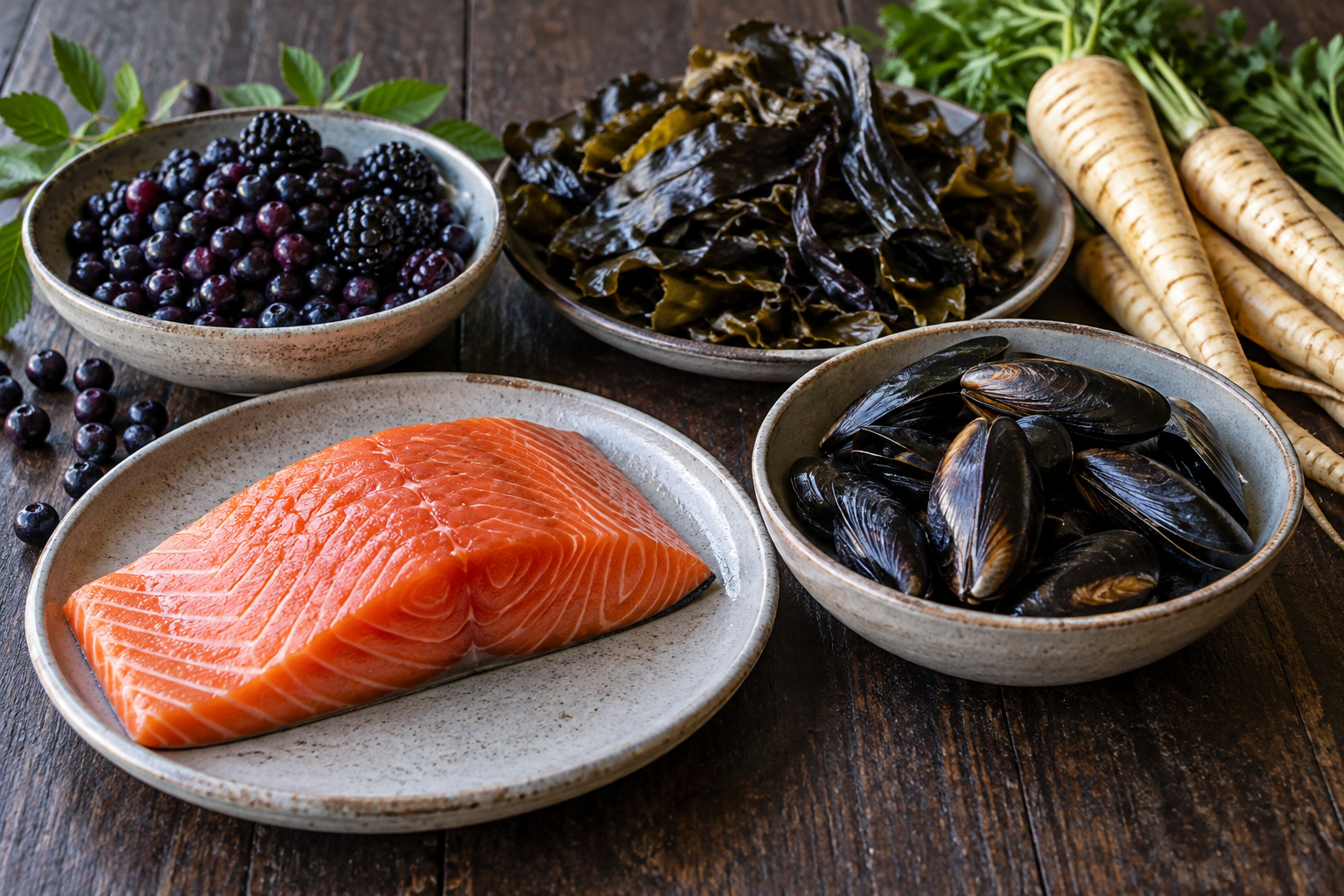
A quick berry sauce provides tartness beside rich fish. It is made in a clean saucepan, while the salmon cooks separately, which makes doneness easier to control. The berries are a contemporary pairing here; their presence does not prove that this combination existed in the ancient Columbia Basin.
Modern adaptation: The pan sauce, cultivated blackberries or blueberries, lemon, oil, and exact proportions are modern choices. The regional sources establish ingredient histories rather than this dish. It is not presented as a recovered ancient recipe or as endorsed by a Native nation.
Cook it today
Yield: 4 portions · Prep 10 min · Cook 20 min (approximate)
Ingredients
- 4 salmon fillets, about 150 g each
- 200 g cultivated blackberries or blueberries (1½ cups)
- 60 ml water (¼ cup)
- 15 ml lemon juice (1 tablespoon)
- 10 g sugar (2 teaspoons), optional
- 20 ml neutral oil (4 teaspoons)
- 3 g salt (½ teaspoon), divided
Method
- Put the berries and water in a small saucepan and bring to a gentle simmer. Cook for 6–8 minutes, pressing a few berries with a spoon while leaving some whole. Stir in the lemon juice and optional sugar, then keep warm on very low heat.
- Check the salmon for bones and pat dry. Sprinkle with most of the salt. Heat the oil in a wide nonstick or well-seasoned skillet over medium heat. Place the fish skin-side down and cook for 4–5 minutes without repeatedly moving it.
- Turn carefully with a broad spatula, lower the heat, and cook for about 3–5 minutes more, depending on thickness. Check the center with a food thermometer: fish should reach 63°C/145°F. If necessary, cover briefly to finish the thickest part.
- Taste the sauce and add the remaining salt only if needed. If very thick, loosen with a spoonful of water. Spoon a little sauce beside each fillet rather than flooding it, and offer the rest separately. Keep the sauce utensil clear of raw fish.
Substitutions
Use grocery trout or a mild white fish, adjusting the timing to thickness while keeping the same safe endpoint. Frozen cultivated berries can be used directly in the saucepan. They are an available substitute rather than an assertion about a particular historical wild berry.
Serving
Serve with cooked vegetables and a simple starch. A few spoonfuls of sauce are enough to balance the fish. For a less sweet plate omit sugar entirely; the natural variation between berries is part of cooking from fruit.
Storage
Refrigerate cooked fish and sauce separately within 2 hours at 4°C/40°F or colder. Use fish within 2 days and sauce within 3 days. Reheat leftovers to 74°C/165°F; fresh fish texture will be better on the first day.
Sources and evidence notes
- Salmon Culture — Columbia River Inter-Tribal Fish Commission: Tribal fisheries commission explains the central place of salmon; not a recipe license or endorsement.
- Plants — Nez Perce National Historical Park: Public historical account identifies regional berry species; modern cultivated substitutes are distinguished.
- Safe Minimum Internal Temperatures — FoodSafety.gov: Current modern food-safety endpoints, separate from historical practice.
These original modern recipes are inspired by documented ingredients and food traditions. They are not recovered ancient recipes or claims of tribal endorsement. Sources support the historical context; quantities, combinations, substitutions and appliance methods are modern.