Southwest · Precontact agricultural ingredient context
Food history and kitchen connections
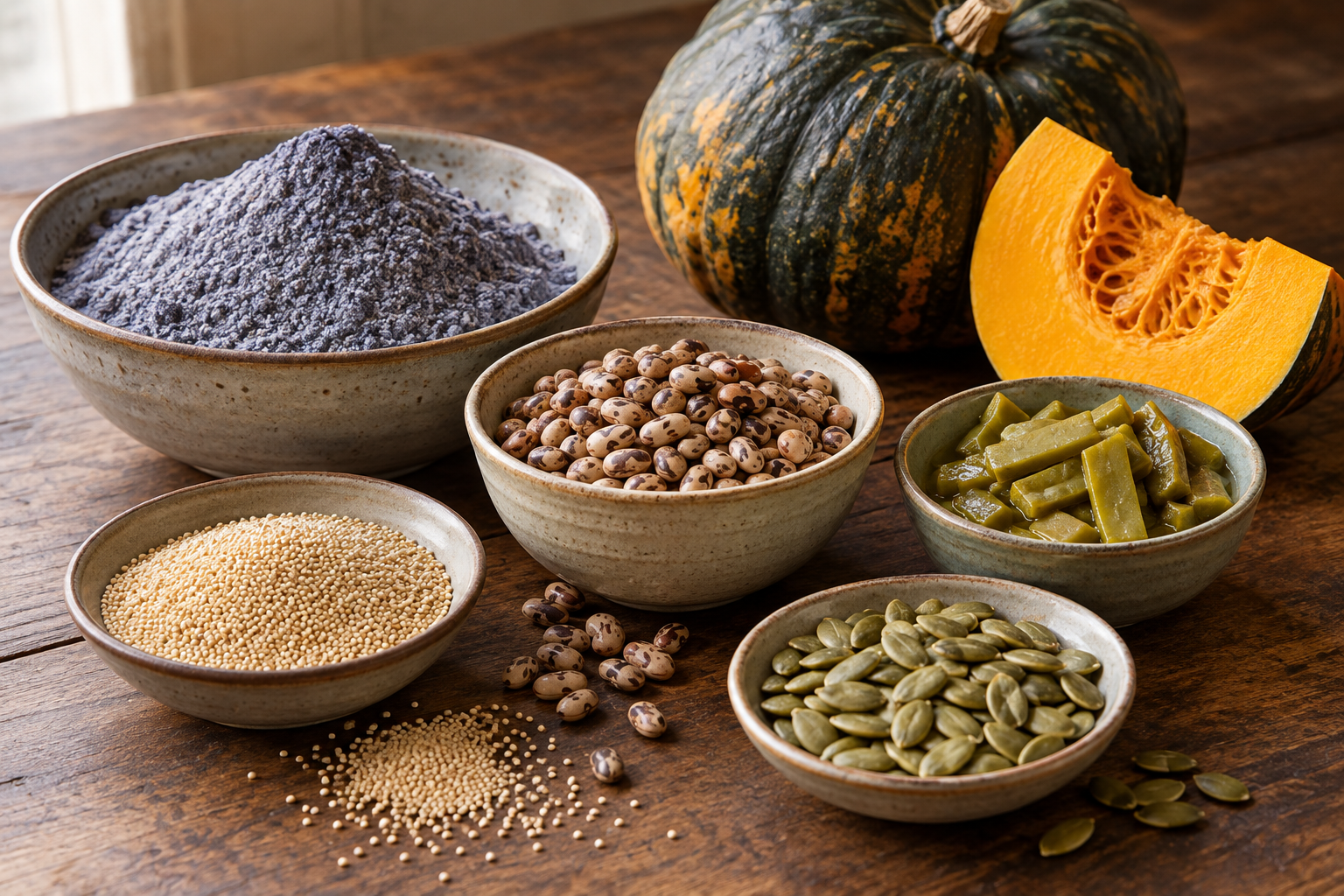
Tonto National Monument describes corn, beans, and squash among the crops of the archaeological Salado period, approximately 1250–1450 CE. That is a specific precontact setting, not a claim that all Southwestern peoples ate the same meals. A modern bake can acknowledge those crops without inventing a named historical casserole.
Canned hominy provides substantial kernels that stay distinct beside soft winter squash. Buying it already processed also removes any need to handle alkaline ingredients at home. The contrast matters: mash all the ingredients and this becomes a different dish. Here, the oven develops browned squash edges around a moist center.
Modern adaptation: Commercial hominy, canned beans, an ovenproof dish, oil, onion, and the baking method are practical modern choices; the source establishes crops rather than this combination. It is not presented as a recovered ancient recipe or as endorsed by a Native nation.
Cook it today
Yield: 4 substantial portions · Prep 15 min · Cook 45 min (approximate)
Ingredients
- 600 g peeled winter squash, cut into 2 cm cubes (about 4 cups)
- 480 g drained canned hominy (about 3 cups)
- 240 g drained canned black or pinto beans (about 1½ cups)
- 120 g onion, chopped (1 medium)
- 30 ml neutral oil (2 tablespoons)
- 150 ml low-sodium vegetable stock (⅔ cup)
- 3 g salt (½ teaspoon), or less if stock is salted
- 30 g pumpkin seeds (¼ cup)
Method
- Heat the oven to 200°C/400°F. Toss the squash and onion with the oil and salt in a large shallow baking dish. Spread into one layer and roast for 20 minutes, stirring once, until the squash begins to soften and color.
- Rinse the hominy and beans and drain thoroughly. Fold them into the squash, pour the stock around the edges, and cover the dish tightly with foil or a lid. Bake for 15 minutes so the kernels heat through without drying out.
- Remove the cover and sprinkle on the pumpkin seeds. Bake for 8–10 minutes more, until the liquid has mostly absorbed and the squash yields easily to a fork. Check several places in the center; a casserole should reach 74°C/165°F throughout.
- Rest for 5 minutes before serving. If the bake seems dry before the squash is tender, add 30–60 ml hot water and cover again briefly. If it is too wet, give it a few uncovered minutes rather than stirring it into a mash.
Substitutions
Use cooked butternut, kabocha, or peeled pumpkin of similar firmness. Canned sweet corn is an available substitute for hominy, but makes a sweeter, softer dish; reduce the stock to 100 ml.
Serving
Serve in wide bowls with leafy vegetables and a tart fruit relish on the side. The bake is substantial enough for a light meal; for a larger dinner, offer an additional protein separately.
Storage
Cool leftovers promptly in shallow containers; refrigerate within 2 hours at 4°C/40°F or colder for up to 3 days. Reheat covered with a splash of water to 74°C/165°F. Freeze for up to 1 month.
Sources and evidence notes
- The Salado Culture — Tonto National Monument: Identifies the archaeological Salado designation and approximately 1250–1450 CE context.
- The Salado of the Tonto Basin — Tonto National Monument: Regional agriculture including amaranth; distinguish prehistoric ingredients from a modern dish.
- Safe Minimum Internal Temperatures — FoodSafety.gov: Current modern food-safety endpoints, separate from historical practice.
These original modern recipes are inspired by documented ingredients and food traditions. They are not recovered ancient recipes or claims of tribal endorsement. Sources support the historical context; quantities, combinations, substitutions and appliance methods are modern.