Southwest · Ancestral Pueblo crop context
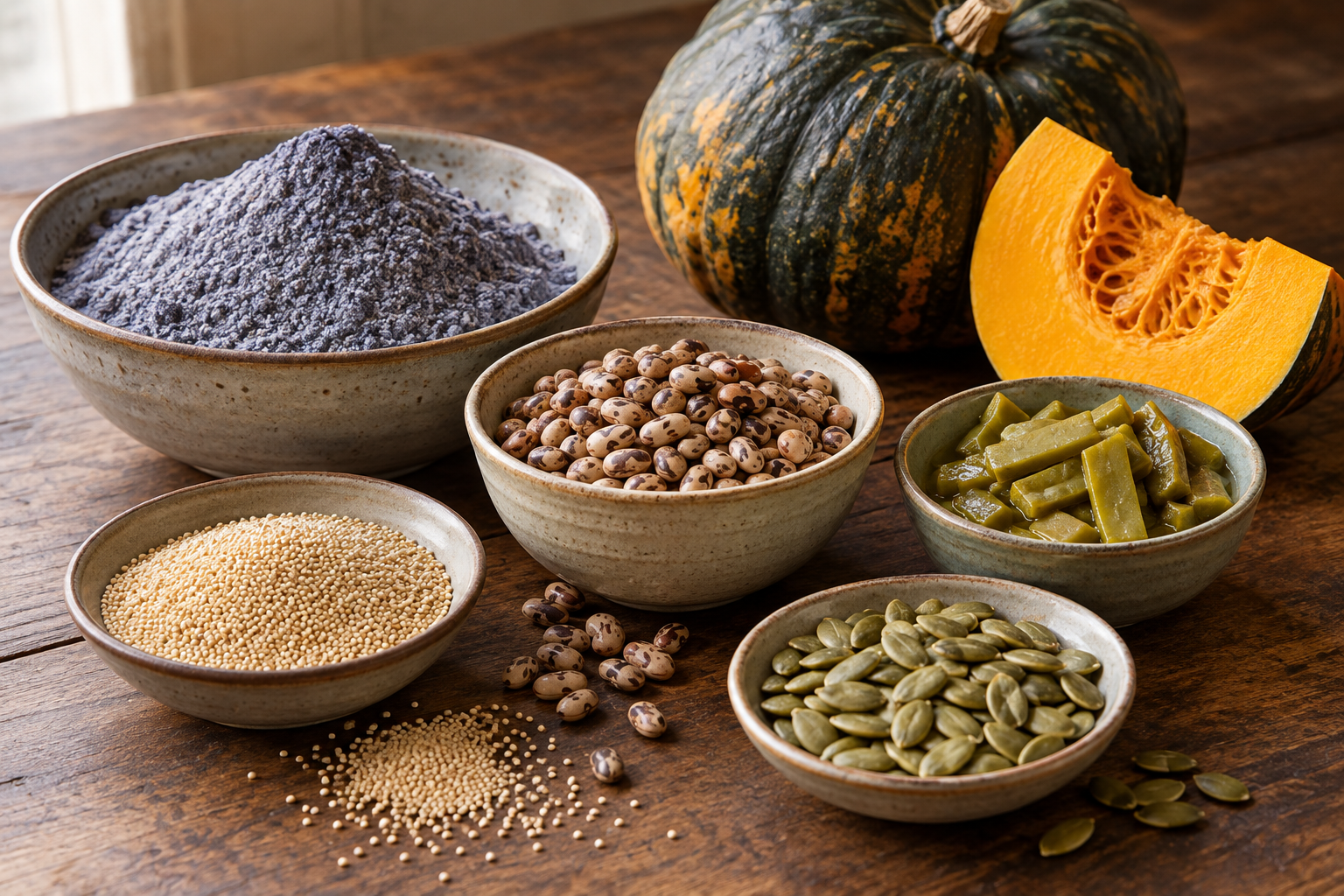
Food history and kitchen connections
Corn and squash belong to the documented food history of the northern New Mexico Pueblo region. Bandelier’s farming account and Aztec Ruins’ heritage garden provide the ingredient connection. Neither supplies the measured breakfast below, and the modern Pueblo peoples connected with these places have continuing, distinct food traditions.
For a weekday bowl, finely ground cornmeal is easier to handle than whole kernels. Pumpkin puree adds body without hiding the grain. Keeping the sweetness optional makes the result suitable beside an egg or roasted vegetables as well as fruit. The blue color is attractive, but yellow cornmeal works equally well.
Modern adaptation: The saucepan, canned pumpkin, seed garnish, and exact proportions are present-day choices; this is not Hopi piki or a ceremonial corn preparation. It is not presented as a recovered ancient recipe or as endorsed by a Native nation.
Cook it today
Yield: 4 breakfast portions · Prep 5 min · Cook 18 min (approximate)
Ingredients
- 160 g fine blue cornmeal (about 1 cup)
- 800 ml water (3⅓ cups), plus extra as needed
- 240 g plain canned pumpkin puree (about 1 cup; not pie filling)
- 2 g salt (⅓ teaspoon)
- 30 g hulled pumpkin seeds (¼ cup)
- 15 ml maple syrup (1 tablespoon), optional
Method
- Put the water and salt in a heavy saucepan and bring to a gentle boil. Reduce the heat so the surface bubbles slowly; vigorous boiling makes cornmeal spit. Keep a whisk and a wooden spoon nearby before adding the grain.
- Sprinkle in the cornmeal in a thin stream while whisking continuously. Do not dump it into the center. Once the mixture is smooth, change to a spoon and cook over low heat for 12–15 minutes, stirring around the base and corners.
- Stir in the pumpkin puree and cook for 3 minutes more. Taste a cooled spoonful: the grain should feel soft rather than gritty. Add hot water a tablespoon at a time if it becomes stiff before it softens; a spoon drawn through should leave a brief trail.
- Toast the seeds in a dry skillet over medium-low heat for 2–3 minutes, moving them often, until fragrant. Spoon the porridge into warm bowls, scatter over the seeds, and add the optional syrup at the table.
Substitutions
Use finely ground yellow cornmeal if blue is unavailable; coarse polenta may need much longer, so follow its packet. Replace pumpkin with an equal weight of smooth cooked winter squash. The seed garnish may be omitted for a softer bowl.
Serving
Serve immediately while loose and creamy. For a savory version, leave out the syrup and add a spoonful of warm cooked beans. Offer toppings separately so the corn remains the central flavor.
Storage
Cool promptly in shallow containers and refrigerate within 2 hours at 4°C/40°F or colder for up to 3 days. Reheat with water, stirring, to 74°C/165°F; cold cornmeal thickens considerably.
Sources and evidence notes
- Ancestral Pueblo Farming — Bandelier National Monument: Evidence for crops and regional farming; not a surviving recipe.
- The Heritage Garden and Ancestral Puebloan Agriculture: Archaeological and ethnobotanical context; the modern garden does not reproduce an ancient menu.
These original modern recipes are inspired by documented ingredients and food traditions. They are not recovered ancient recipes or claims of tribal endorsement. Sources support the historical context; quantities, combinations, substitutions and appliance methods are modern.