Northeast · Haudenosaunee corn and bean context; original modern adaptation
Food history and kitchen connections
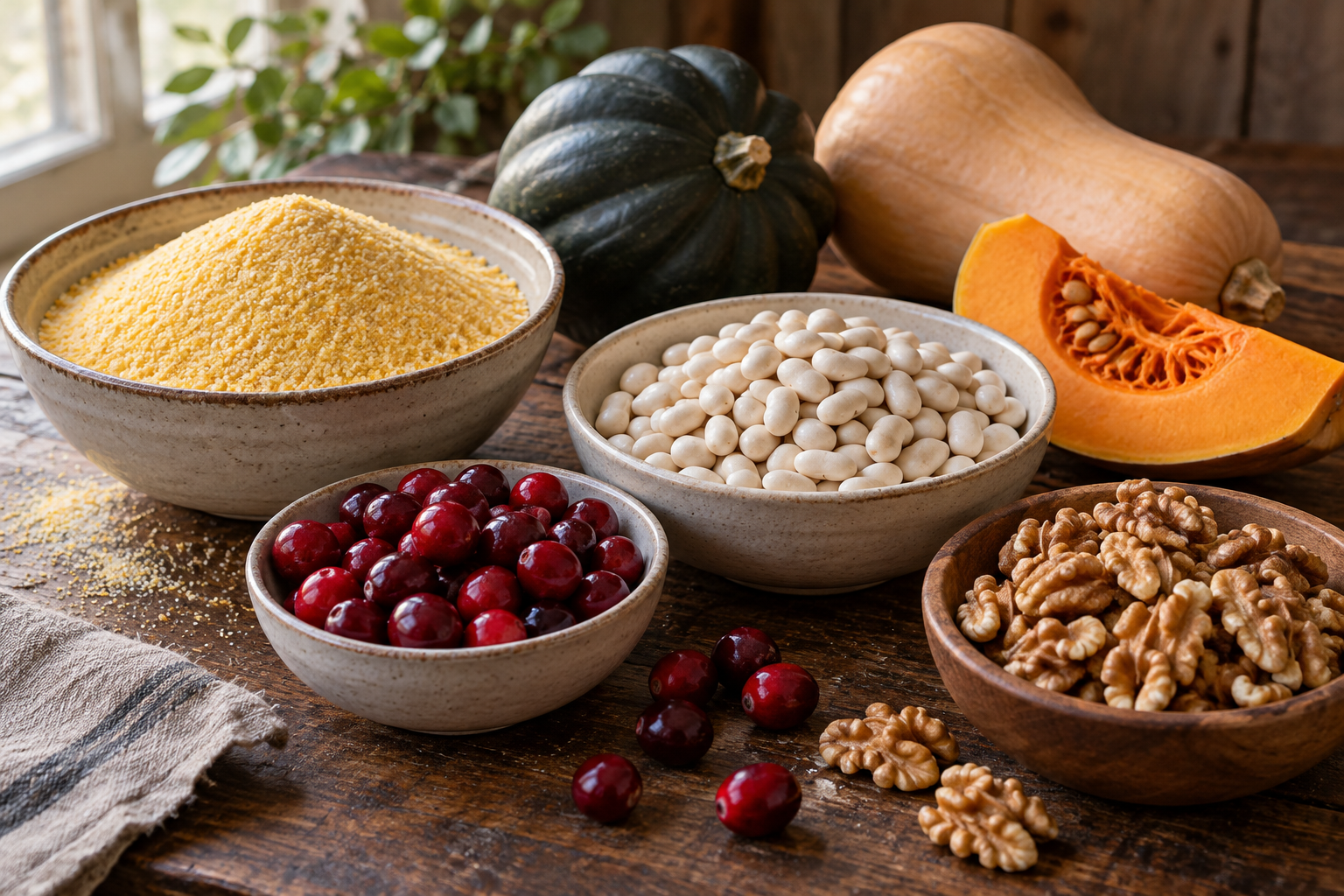
Corn appears in several forms in the Onondaga Nation’s public description of its foodways, including ground corn and boiled bread. Ganondagan’s public food programming includes cornbread wheels and corn-processing demonstrations. Those accounts point to a much broader corn tradition than a single loaf or familiar sweet cornbread; they do not authenticate these pan-cooked cakes.
This version gives cooked beans and cornmeal a different job from their role in a soup. Mashed beans hold moisture while finely ground commercial masa harina supplies structure. A brief rest lets the dough hydrate before it reaches the skillet. The result should be a small, tender cake that can be lifted with a spatula, with a soft interior rather than a brittle crust. A separately blended sunflower sauce makes the plate substantial without turning a historical discussion into a claim about a recovered recipe. The sauce and skillet method are present-day choices made for an ordinary home kitchen.
Modern adaptation: These are original modern bean cakes inspired by documented corn foods. They are not Haudenosaunee boiled cornbread or a reproduction of a community recipe. Commercial masa harina, a blender, lemon juice, and a nonstick skillet are deliberate modern conveniences; masa harina is not interchangeable with every heirloom corn flour.
Cook it today
Yield: 4 servings, about 8 small cakes · Prep 20 min · Cook 20 min (approximate)
Ingredients
- 1 can (15 ounces) cooked kidney beans, drained and rinsed
- 1 cup masa harina, plus 1 tablespoon if needed
- 3/4 cup warm water, plus more as needed
- 1/2 teaspoon fine salt, divided
- 2 tablespoons sunflower oil, divided
- 1/2 cup unsalted shelled sunflower kernels
- 1/2 cup hot water for sauce
- 1 tablespoon lemon juice
Method
- Make the sauce first. Put sunflower kernels, 1/2 cup hot water, lemon juice, and 1/4 teaspoon salt in a heatproof bowl. Let stand for 10 minutes, then allow it to cool enough for your blender. Blend according to the appliance instructions, stopping to scrape down. Never seal hot liquid in a blender not designed for it. A slightly grainy, spoonable sauce is fine; add cool water a teaspoon at a time if it is too thick.
- Drain the rinsed beans thoroughly, then mash in a bowl until no whole beans remain. Stir in masa harina, 3/4 cup warm water, and the remaining salt. Cover and rest for 10 minutes before deciding whether the dough needs adjustment.
- Pinch off a piece and flatten it. It should hold a smooth edge and lift without smearing. If it cracks, knead in water a teaspoon at a time. If it sticks heavily to your fingers, knead in the extra tablespoon masa and rest for 2 minutes. Divide into eight equal portions and shape into cakes about 3 inches across and 1/2 inch thick.
- Warm half the oil in a wide nonstick skillet over medium heat. Add four cakes with space between them. Cook for 4 to 5 minutes on the first side, until the base is firm enough to lift with a broad spatula. Turn once and cook the second side for 4 to 5 minutes. Lower the heat if the surfaces darken quickly.
- Cut one cake through the middle: the center should be moist and hot, with no dry, floury layer. Cook a little longer over lower heat if needed. Repeat with the remaining oil and cakes; two batches take about 16 to 20 minutes in all. Serve with the sauce alongside so the browned surfaces stay distinct.
Substitutions
Pinto beans can replace kidney beans if thoroughly drained and mashed. Shelled pumpkin seeds can replace sunflower kernels in the sauce; expect a different color and flavor. Buy masa harina, not ordinary cornmeal or corn starch: they do not bind this dough in the same way.
Serving
Pair with roasted squash or steamed greens. Make small cakes for easier turning; their tenderness is part of the intended texture.
Storage
Refrigerate cakes and sauce separately within 2 hours, up to 3 days at 40°F or below. Reheat cakes to 165°F in a covered skillet with a splash of water.
Kitchen cues and troubleshooting
For a meal with several dishes, blend the sauce before shaping the cakes. Keep uncooked portions covered while the first batch cooks. If a cake breaks as you turn it, leave the next cake on its first side a little longer and slide the spatula fully underneath rather than lifting from an edge.
Sources and evidence notes
- Onondaga Nation: Food: Public tribal account of corn, beans, squash, fishing, game, spring plants, strawberries, and responsible harvesting; supports ingredient context, not this recipe.
- Ganondagan: They Sustain Us, Indigenous Food Event: Public program identifies Three Sisters teaching, corn processing, and cornbread wheels; not evidence for the recipe below.
- King Arthur Baking: Masa Harina preparation guide: Manufacturer guidance on masa dough hydration and teaspoon-size water adjustments; not a source for the historical context or this bean-cake formula.
These original modern recipes are inspired by documented ingredients and food traditions. They are not recovered ancient recipes or claims of tribal endorsement. Sources support the historical context; quantities, combinations, substitutions and appliance methods are modern.