Northeast · Haudenosaunee ingredient traditions; original modern adaptation
Food history and kitchen connections
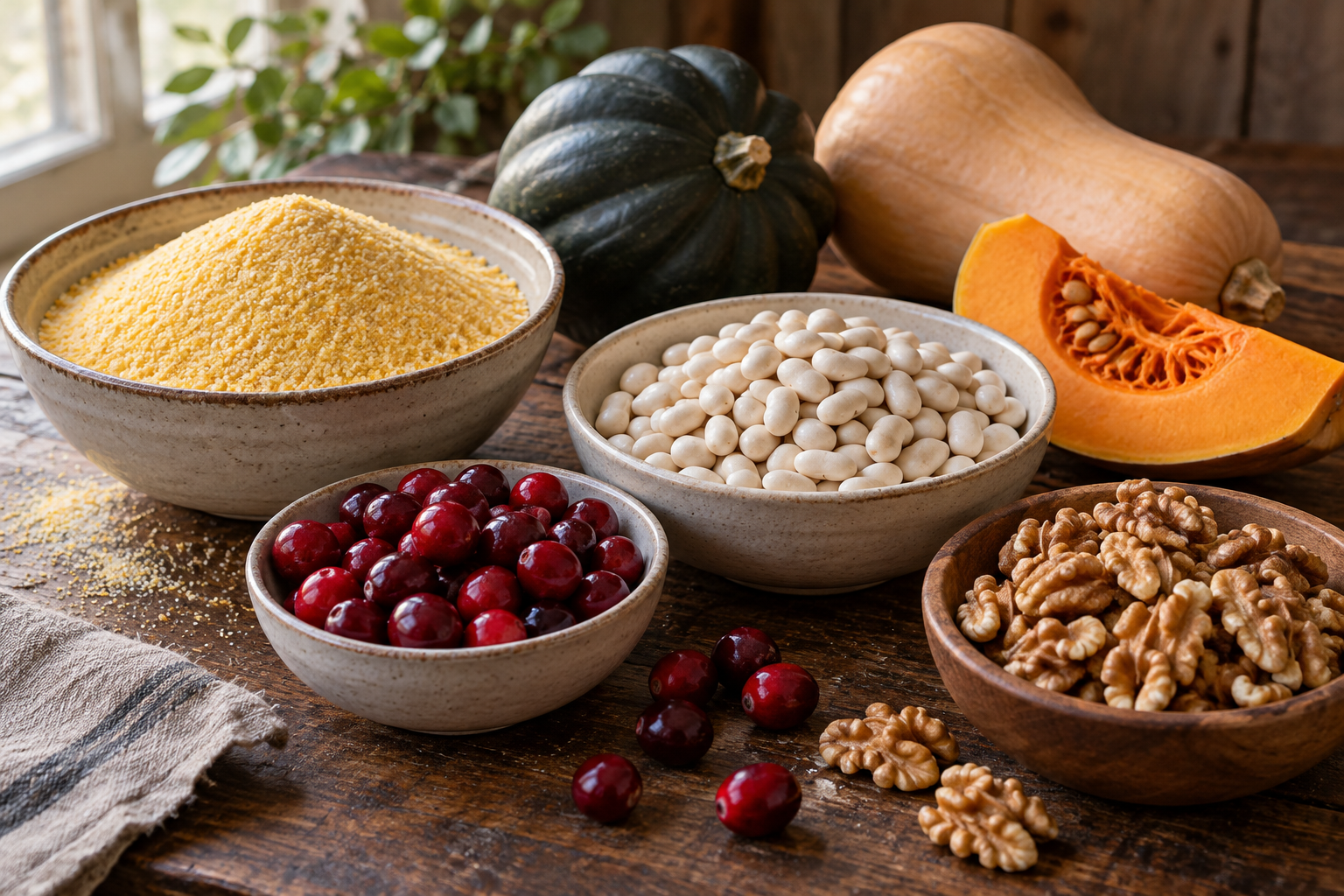
Onondaga Nation identifies corn, beans, and squash as foundational foods and describes dried corn made into soup, mush, and boiled bread. Ganondagan’s White Corn Project connects white corn with living Haudenosaunee farming. These sources support the ingredients in this pot; they do not supply its measurements or establish that this particular stew existed in antiquity.
A stew provides a useful way to notice differences among the three crops. Tender squash can soften into the broth, beans keep their shape, and large corn kernels remain pleasantly chewy. The aim here is a balanced supper with visible ingredients rather than a uniform purée. Calling the dish an adaptation also leaves room for the important differences between community-grown heirloom white corn and a supermarket can of hominy. Both can feed a household, but they do not carry identical histories, processing methods, or relationships to the people who grow them.
Modern adaptation: This is an original stovetop recipe inspired by documented Haudenosaunee ingredients, not an authenticated ancient dish. Canned hominy, canned beans, packaged stock, cultivated butternut squash, bottled oil, and measured salt make it practical today. Commercial hominy is a convenience substitute, not a claim that it is Haudenosaunee heirloom corn.
Cook it today
Yield: 4 main-course servings · Prep 15 min · Cook 30 min (approximate)
Ingredients
- 1 tablespoon sunflower oil
- 1 medium yellow onion, diced
- 3 cups peeled butternut squash in 3/4-inch cubes
- 1 can (15 ounces) cooked white beans, drained and rinsed
- 1 can (15 ounces) white hominy, drained and rinsed
- 3 cups low-sodium vegetable stock
- 1/2 teaspoon fine salt, plus more to taste
- 1/4 cup unsalted sunflower kernels, lightly crushed
Method
- Warm the oil in a heavy saucepan over medium heat. Add the onion and cook for 6 minutes, stirring, until translucent without letting it burn.
- Add squash, beans, hominy, stock, and salt. Bring to a boil, then reduce to a gentle simmer and partially cover the pan.
- Cook for 20 to 25 minutes, stirring occasionally, until the squash is tender and the hominy is hot. Mash a few squash cubes against the pan to thicken the broth.
- Stir in the crushed sunflower kernels. Simmer uncovered for 3 minutes. Add a little water if the stew has become thicker than you prefer.
- Taste the broth before adding more salt. Divide among four bowls, making sure each receives beans, squash, and hominy.
Substitutions
Use cooked hulled heirloom white corn in place of canned hominy, following its producer’s preparation directions first. Pumpkin can replace butternut squash. Use pumpkin seeds for a sunflower-free version.
Serving
Serve as a thick supper stew with a simple green salad. Keep the seasoning light enough to taste the corn and squash separately.
Storage
Refrigerate in shallow covered containers within 2 hours. Keep up to 3 days at 40°F or below; reheat to 165°F, adding water as needed. Freeze up to 2 months.
Sources and evidence notes
- Onondaga Nation: Food: Public tribal account of corn, beans, squash, fishing, game, spring plants, strawberries, and responsible harvesting; supports ingredient context, not this recipe.
- Ganondagan: About the White Corn Project: Documents Haudenosaunee white corn continuity and current restoration work; this recipe is independently developed.
These original modern recipes are inspired by documented ingredients and food traditions. They are not recovered ancient recipes or claims of tribal endorsement. Sources support the historical context; quantities, combinations, substitutions and appliance methods are modern.