← Research · All current investigations
Current evidence context
#15 · Sodium-ion pulse charging
Evidence context · reviewed 2026-11-01
Current assessment: The original universal penalty framing is replaced by a mechanism-dependent comparison.
Evidence scope: Conditional charge-transfer mathematics and an uncalibrated lumped-cell model. No cell measurements; the proposed frequency window is parameter-dependent.
Reproduction status: Source-reported computations and derivations; not independently reproduced during publication or this editorial review.
Next milestone: Specify matched charge throughput and temperature controls before testing plating onset; do not present the model window as a measured cell property.
Editorial assessment of retained reports, not a new experiment, full reproduction, peer review or novelty certification. All original hypotheses, negative results and revisions remain archived.
Original supplied report · prose preserved
07 · Pulsed charging of sodium-ion cells (#15) — the comparison, not the chemistry, decides the answer
07 · Pulsed charging of sodium-ion cells (#15) — the comparison, not the chemistry, decides the answer
Priority 7 · status: the published negative result is reproduced as the expected outcome of a correctly specified comparison; the direction is re-scoped to a measurable frequency–duty window.
The original idea: sodium-ion cells will be sold into pulsed duty, the literature is constant-current, and a “pulse penalty factor” above 1.3 in capacity fade may exist. It was written before the first pulse study appeared. That study — Schwedland, Stepien, Ferrero, Bäthge & Adelhelm, Batteries & Supercaps 2026, DOI 10.1002/batt.70446, 150 mAh NFPP/hard-carbon pouch cells — found no fast-charge benefit, a higher overpotential, and no shortening of the CV step, and noted that pulse trains above ~100 Hz are not reliably deliverable on standard instrumentation.
This dossier explains why that result is not surprising, and what would have to be measured for a pulse effect to be real.
1. The comparison is the experiment
At matched RMS current — the original protocol — a
square train of duty d carries average current
j_rms·√d. At d = 0.25 the pulsed arm therefore
delivers half the charge per hour of the DC arm. After
the same number of “cycles” it has accumulated fewer equivalent full
cycles. Any fade comparison in that design is biased in favour of
pulsing before a single cell is cycled.
The correct control is matched charge throughput:
same ampere-hours in the same time, hence j_peak = j_avg/d
and rms = j_avg/√d. The pulsed arm then runs hotter and at
higher peak current, which is the physically meaningful comparison.
Every number below uses matched throughput.
This alone explains a literature of contradictory results: Brand et al. (IEEE TVT 2018) found low-frequency ripple 1–2 % worse; Uddin et al. (Appl. Energy 2016) found the opposite frequency trend; Chang et al. (IEEE TPEL 2020) found nothing except below 10 Hz. Those studies differ in frequency, amplitude, duty and charge throughput, and several compare arms that do not deliver the same charge.
2. Why the sign is not free: the overpotential is concave
Charge-transfer overpotential follows Butler–Volmer. Inverted for symmetric kinetics:
η(j) = (2RT/F) · asinh( j / 2j₀ )asinh is concave and passes through zero. At matched
throughput, the time-averaged overpotential of a pulse
train is therefore lower than the DC overpotential at the same
average current, while the peak overpotential is
higher:
| duty | peak current (× avg) | mean η / η_DC | peak η / η_DC |
|---|---|---|---|
| 10 % | 10 | 0.48 | 4.81 |
| 25 % | 4 | 0.75 | 3.00 |
| 50 % | 2 | 0.92 | 1.83 |
(figures/mean_vs_peak.png.) This is the whole reason the
literature disagrees with itself. A damage channel driven by the
mean overpotential (slow SEI growth) says pulsing is
better; a channel driven by the instantaneous
overpotential crossing a plating threshold says pulsing is
worse. Both are correct statements about different
mechanisms, and most papers measure capacity fade — which is the sum of
them.
3. What the model says about the plating channel
A lumped cell model (charge-transfer overpotential + first-order concentration polarisation with τ = 60 s + a plating reaction above a 100 mV threshold with re-intercalation on rest; parameters order-of-magnitude, no cell data used) gives:
| frequency | duty 10 % | duty 25 % | duty 50 % |
|---|---|---|---|
| 1 × 10⁻⁴ Hz | 0.00 | 0.01 | 0 |
| 3 × 10⁻⁴ Hz | 0.48 | 0.52 | 0 |
| 1 × 10⁻³ Hz | 6.75 | 5.55 | 0 |
| 3 × 10⁻³ Hz | 6.28 | 3.82 | 0 |
| 1 × 10⁻² Hz | 4.76 | 0.44 | 0 |
| ≥ 3 × 10⁻² Hz | ~4.6 (flat) | 0 | 0 |
(net plating charge, arbitrary units;
figures/plating_vs_frequency.png.) The structure is not a
multiplicative “penalty factor” — it is a window:
- A duty threshold. At 50 % duty the peak current only doubles and the peak overpotential (85 mV) stays below the plating threshold: no plating at any frequency. At 25 % duty it crosses only below ~30 mHz. At 10 % duty it crosses everywhere.
- A frequency window. The penalty is largest when the pulse period is comparable to the concentration-polarisation time (minutes), i.e. around 10⁻³ Hz, because the peak then carries both the charge-transfer and the polarisation overpotential.
- A high-frequency plateau. Above ~30 mHz the polarisation is filtered to its mean and the penalty is set only by the peak charge-transfer overpotential — frequency-independent. This is the regime the 2026 study most likely sampled, and it is where its “higher overpotential, no benefit” result lives.
Recovery is the strongest knob
(results/sodium_pulse.json): shortening the
re-intercalation half-life from 6.9 h to 4 min cuts the accumulated
plating charge at 1 mHz from 122.6 to 1.85 arbitrary units. Whether that
recovery exists is a chemical question, and it is measurable.
4. The experiment that would settle it
The original design (three duty profiles, 2 000 cycles, post-mortem) is right in spirit but tests the wrong axis first. Run the cheap, decisive measurement before the life test:
- Plating onset map, not cycle life. Use operando ²³Na solid-state NMR (the method used in eScience 2026 for hard-carbon plating onset) or, if unavailable, a voltage-relaxation plating assay. Sweep (frequency × duty) at matched throughput with 3 cells per point, 50 cycles each. Output: the boundary in the (f, d) plane where plating charge becomes detectable.
- Then one life test at the worst point found, and one at a point outside the window, 2 000 cycles, 4 cells per arm, matched throughput and matched temperature (the pulsed arm runs hotter; that must be controlled or reported as a covariate).
- Report mean and peak overpotential separately, as the model says they move in opposite directions. A paper reporting only capacity fade cannot distinguish the mechanisms.
Sample size: with cell-to-cell CV of 8 % on fade, detecting a 20 %
difference needs 3 cells per arm; 10 % needs 11
(results/sodium_pulse.json, power). The
decisive plating map needs more conditions than replicates — 3 cells ×
~12 conditions × 50 cycles is about six weeks on a 12-channel
cycler.
5. Revised claim
At matched charge throughput, pulsing necessarily raises the peak overpotential and lowers the mean overpotential of a sodium-ion cell. Which of these dominates the ageing rate is not settled by capacity-fade data alone. The predicted plating penalty is a threshold in duty and a window in frequency (millihertz to tens of millihertz), not a multiplicative factor; the single published pulse study sampled a regime where the model predicts no penalty, and its negative result is consistent with that.
This is a narrower claim than “pulse penalty factor > 1.3”, and it is falsifiable in weeks rather than years.
6. Limits and honesty
- The model is lumped and phenomenological. The plating threshold, exchange current and recovery rate are assumed, not measured for any specific cell.
- No sodium plating threshold is quoted from the literature here; the 100 mV value is a modelling parameter, not a measured onset.
- The 2026 study’s full text was not accessible; the summary above is
from its abstract and Crossref metadata (see
_lit/A_battery_prior_art.md§7). - Thermal effects of the higher RMS in the pulsed arm are ignored; at
matched throughput the pulsed arm has
1/√dtimes the RMS heating, which is a separate, well-known confound.
Numbers: results/sodium_pulse.json.
Figures
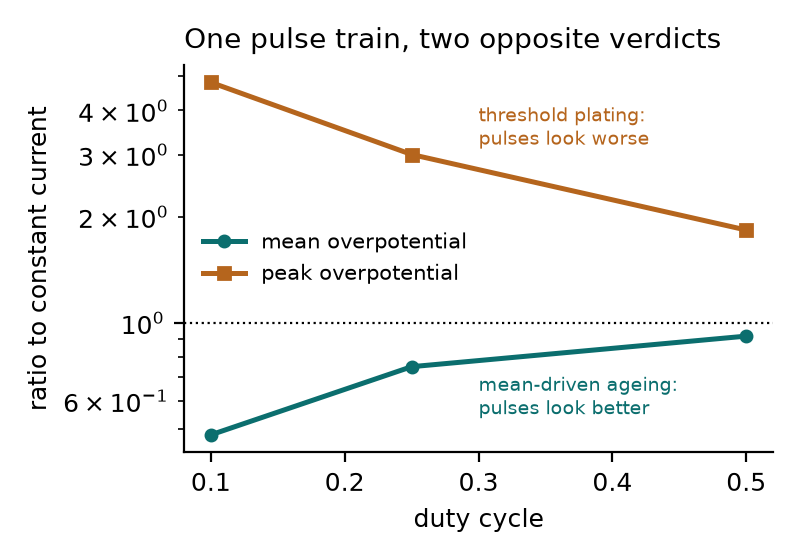
One pulse train, two verdicts: the mean overpotential falls below the DC value while the peak rises above it. Matched charge throughput, Butler–Volmer kinetics.
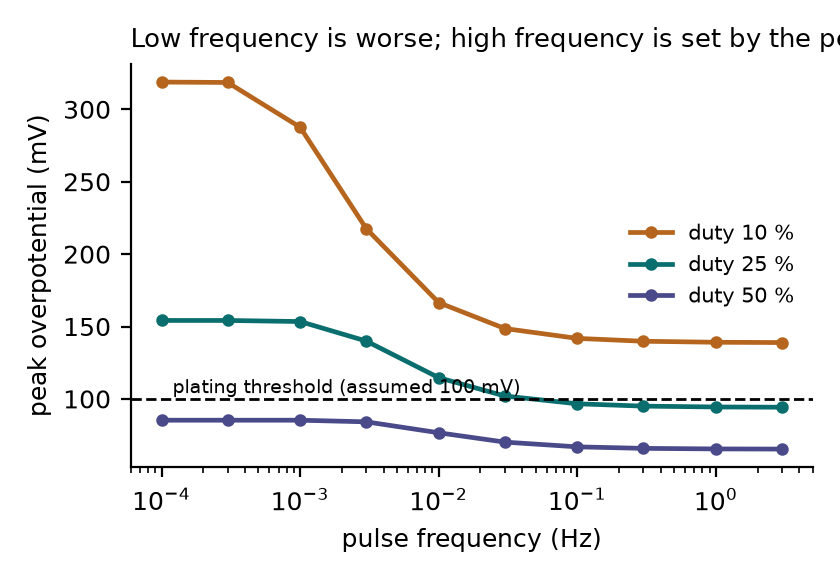
Peak overpotential against frequency. Low frequency is worse (polarisation adds to the peak); at high frequency only the peak current matters.
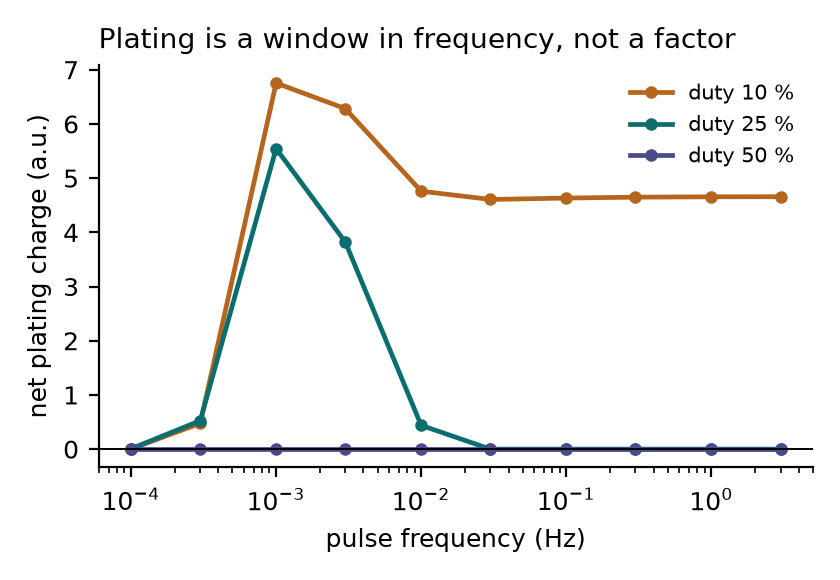
Net plating charge against pulse frequency for three duties. The penalty is a window, not a factor.