Priority 3 · status: mechanism confirmed on paper, turned into a design with a detection floor and a decisive bench test.
The catalogue entry: “A mechanical differentiator could detect rapid chemical changes through the mismatch of two swelling pathways.” The focused dossier already names the right test (concentration steps, ramps and sinusoids; static residual and finite-frequency sensitivity reported separately) and the right kill conditions (gains that do not match leave a false differential; matched time constants make the signal vanish).
What was missing is the transfer function and its consequences. This dossier supplies them, then converts them into a device specification, a detection floor, a bill of materials and a decisive experiment.
Two swelling paths see the same stimulus c(t). Model
each as a first-order Fickian response with gain g_i and
time constant τ_i:
Y_i(s) = g_i / (1 + τ_i s) · C(s)A lever matches the equilibrium gains (ratio
r = g_1/g_2), after which
D(s) = g · [ 1/(1+τ₁s) − 1/(1+τ₂s) ] · C(s)
     = g · (τ₂ − τ₁) · s / [(1+τ₁s)(1+τ₂s)] · C(s)
Three consequences follow immediately, and they are the whole physics of the idea:
At low frequency the output is proportional to the rate
of change, not to the level. A step produces a transient that
decays to zero (figures/step_ramp.png, left); a ramp
produces a steady output proportional to its slope (right). That is the
claimed behaviour, and it is exact in this model.
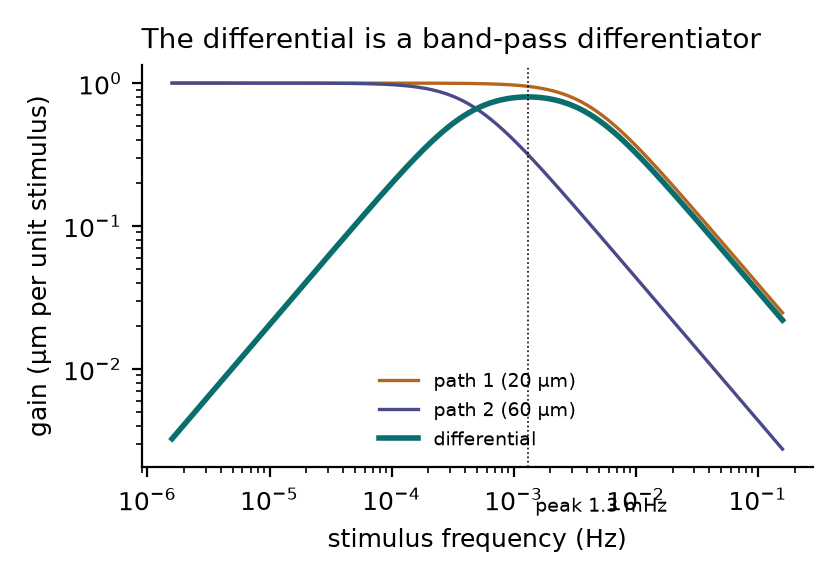
The response is band-pass, not a differentiator without
limit. Above 1/τ₁ the output falls as
1/s. Peak sensitivity is at
ω* = 1/√(τ₁τ₂)which for a factor-9 pair sits near the geometric mean of the two
corner frequencies (figures/bode.png).
If τ₁ = τ₂ the output is identically zero. This is the cleanest control in the experiment, and it is free: the same chemistry cast at the same thickness in both arms must show nothing.
For a thin hydrogel slab the first-mode time constant is
τ = L²/(π²D) with D the cooperative diffusion
coefficient. Equilibrium swelling displacement scales with thickness, so
thickness sets both gain and speed, and a lever can undo the gain but
not the speed. Taking D = 10⁻¹² m²/s (a stated assumption,
an order of magnitude typical of hydrogel films):
| L₁ / L₂ (µm) | τ₁ (s) | τ₂ (s) | peak frequency | ramp sensitivity (s) | bandwidth |
|---|---|---|---|---|---|
| 10 / 30 | 10.1 | 91.2 | 5.2 mHz | 81 s | 16 mHz |
| 20 / 60 | 40.5 | 365 | 1.3 mHz | 324 s | 3.9 mHz |
| 40 / 120 | 162 | 1459 | 0.33 mHz | 1297 s | 0.98 mHz |
| 10 / 90 | 10.1 | 821 | 1.7 mHz | 811 s | 16 mHz |
The design trade is explicit: thin layers buy bandwidth,
thick ones buy rate sensitivity, and (τ₂ − τ₁) is
literally the number of seconds of stimulus that the differential
integrates — a ramp of 1 unit/s produces τ₂ − τ₁ units of
differential displacement in steady state.
With D = 10⁻¹² m²/s and a 20 µm film, the half-time is
28 s and the usable band is
millihertz. This construction cannot detect a fast
transient — the diffusion that makes it swell is the same diffusion that
limits it. What it does buy is a genuine rate channel in a
narrow, predictable band, and immunity to slow level drift within that
band.
The claim should therefore be stated as: a differential swelling
head converts a level-sensing hydrogel into a rate-sensing element with
a band set by the two diffusion times, usable from roughly
1/(2πτ₂) to 1/(2πτ₁). Anyone expecting a
fast chemical alarm will be disappointed; anyone measuring the rate of a
slow process (minutes) gets a device with no electronics beyond a
readout.
Monte Carlo (600 trials per rate; readout noise 0.05 µm RMS at 1 Hz, static gain mismatch 0.5 %, mismatch drift 0.2 %/h):
| stimulus rate (units/s) | total change | P(detect) |
|---|---|---|
| 1 × 10⁻⁵ | 0.006 | 0.00 |
| 3 × 10⁻⁵ | 0.018 | 0.04 |
| 1 × 10⁻⁴ | 0.060 | 0.94 |
| 3 × 10⁻⁴ | 0.180 | 1.00 |
| 1 × 10⁻³ | 0.600 | 1.00 |
(figures/detection.png.) Two competing limits appear in
this table and they are the ones to engineer against:
3σ/((τ₂−τ₁)√N) ≈ 3 × 10⁻⁵ /s — averaging time,
not cleverness, moves it.ε produces an output
ε·c, so the crossover between “rate” and “level” behaviour
is at a total stimulus change of c* = rate·(τ₂−τ₁)/ε. At
ε = 0.5 % and τ₂−τ₁ = 324 s, a 1e-3 /s ramp is
65× above its own leakage — comfortable; a 1e-5 /s ramp is not. The
design requirement computed here is gain matching to about 6.5
% for a 10 % leakage floor at the intended operating point; a
matched pair is the hard part of the build, and the lever is the tool
that makes it adjustable.One humidity chamber, one differential head, one reference
hygrometer. Budget under €3,000 (BILL-OF-MATERIALS.md).
g_i and τ_i;
report the fit residuals. This is the only fitting step.Kill criteria, stated in advance: the differential does not follow the predicted phase across the band; or the matched-time control produces a comparable signal; or the residual on the ramp exceeds the predicted ramp signal at the intended operating rate.
D = 10⁻¹² m²/s is an assumption; the design table
scales as 1/D and must be recomputed for the chosen
chemistry.Numbers: results/n0751_model.json.
Transfer functions. The differential (teal) is a band-pass differentiator: slope +1 below the first corner, −1 above the second, peak at 1/√(τ₁τ₂) = 1.3 mHz.
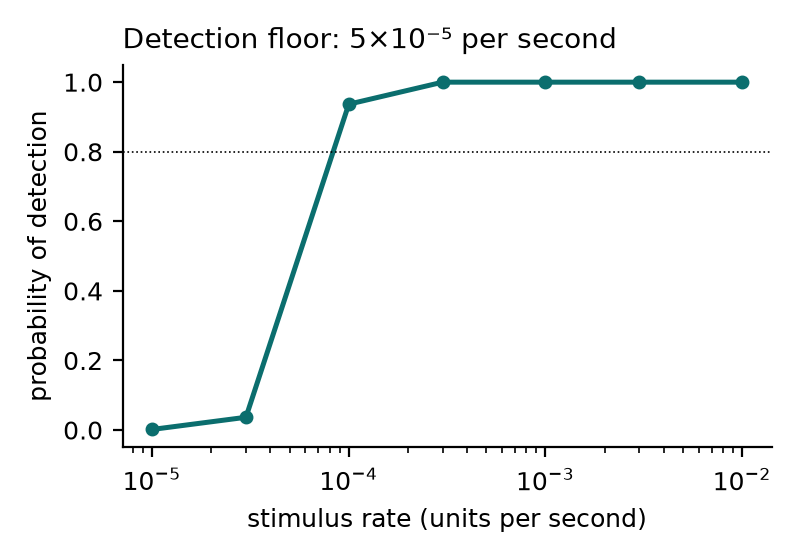
Monte Carlo detection probability against stimulus rate, with 0.5 % gain mismatch, 0.2 %/h drift and 0.05 µm readout noise. Floor near 5×10⁻⁵ per second.
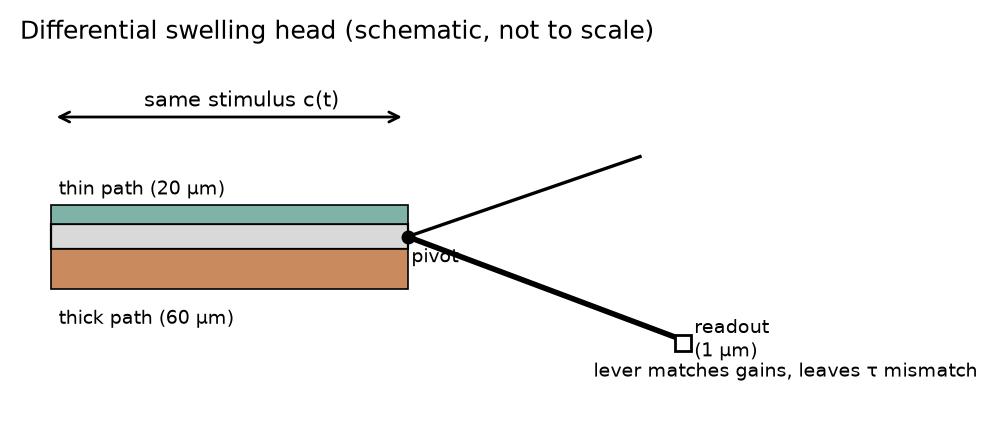
The head: two hydrogel layers of different thickness on a common substrate, a lever that matches equilibrium gains, and a displacement readout. Not to scale.
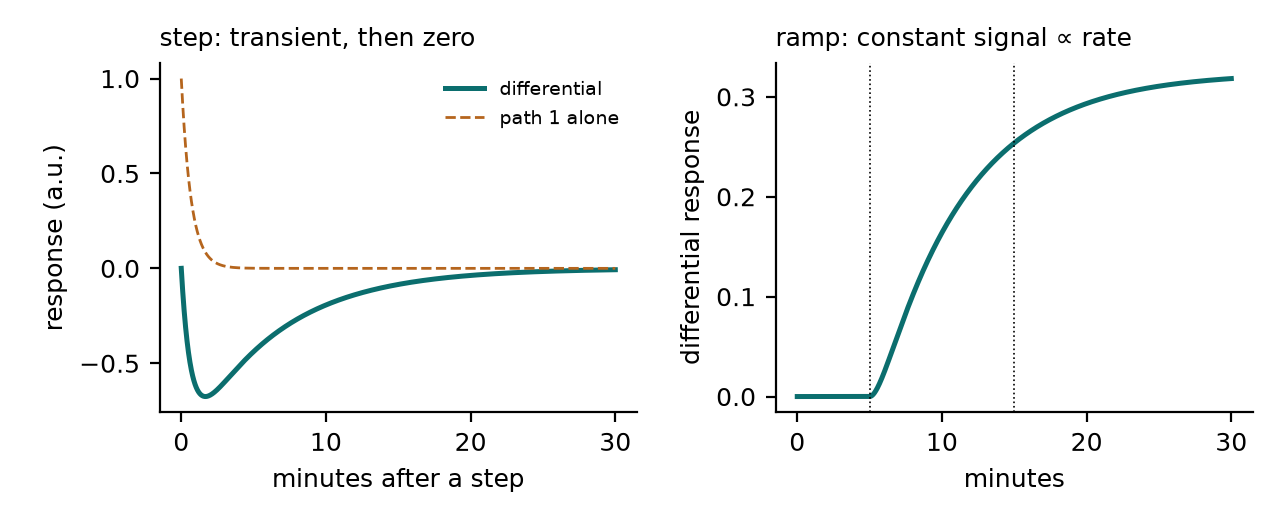
Step response (left): a transient that returns to zero. Ramp response (right): a steady output proportional to the ramp rate.